Note
Go to the end to download the full example code.
15: Is there a response?
Decide, for each channel, whether the brain answered at all, and for how long.
Introduction
Before measuring a bump, ask whether there is a bump to measure. Fitting a model to a
flat, noisy channel always returns some numbers, so a parameter on its own does not
prove a response exists. evoparam.existence answers the yes/no question with a test,
a p-value and an onset and offset, and it does it before and apart from the fit, so
the two decisions do not contaminate each other.
evoparam ships a registry of published rules (van Blooijs, Hays, Keller, Silverstein, F-TRACT) so you can run exactly the rule a paper used, next to evoparam’s own permutation test, and see where they agree.
import warnings

import numpy as np

from evoparam import plots
from evoparam.existence import compare_detectors, list_rules, test_response
from evoparam.sim import simulate_ccep
The data
20 CCEP trials on 6 electrodes. About 60 % of the electrodes answer (p_response=0.6);
the rest see only noise. We know which is which, which lets us read the test honestly.
trials, truth = simulate_ccep(
    20, n_channels=6, p_response=0.6, artifact=False, layout="grid", sfreq=512.0, seed=0,
)  # fmt: skip
print(trials)
<TrialSet | 20 trials × 6 channels × 768 times, -0.500 - 0.998 s, 512 Hz, uV, human, spes>
The test
test_response compares the response window (here 9 to 500 ms) to the pre-stimulus
baseline with a permutation test. For each channel it returns:
significant: the yes/no verdict, after correcting for testing many channels;p_value: how surprising the response is under the null of no response;onsetandoffset: when the response starts and ends, in seconds;snr_db: the size of the response over the baseline, in decibels.
The correction (fdr_bh by default) controls the share of false positives across the
channels, so testing 4 channels or 400 does not flood you with chance hits.
with warnings.catch_warnings():
    warnings.simplefilter("ignore")
    test = test_response(trials, window=(0.009, 0.5), n_permutations=1000, random_state=0)

for channel in range(trials.n_channels):
    name = trials.ch_info["name"][channel]
    verdict = "response" if test.significant[channel] else "no response"
    onset = test.onset[channel]
    detail = ""
    if np.isfinite(onset):
        detail = f"onset {1000 * onset:.0f} ms, {test.snr_db[channel]:.1f} dB"
    print(f"  {name}: {verdict:<12} p={test.p_value[channel]:.3g}  {detail}")
G01: response     p=3.46e-38  onset 27 ms, 21.4 dB
G02: no response  p=0.629
G03: response     p=3e-300  onset 16 ms, 25.5 dB
G04: response     p=3e-300  onset 10 ms, 29.4 dB
G05: no response  p=0.952
G06: no response  p=0.939
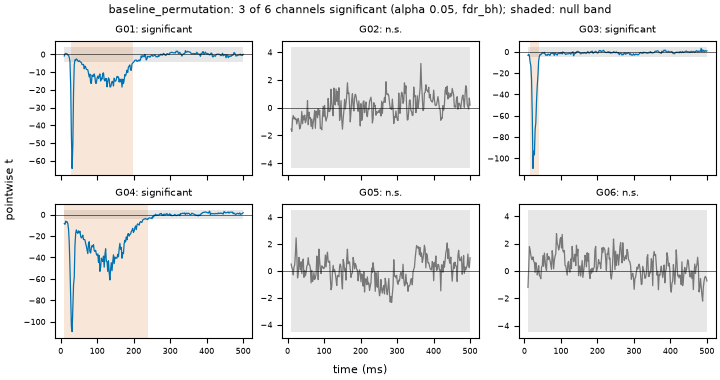
The channels the simulator made responsive come back significant, with an onset near the N1 and a positive SNR; the noise channels get a high p-value and no onset. The figure shows, per channel, the response curve against the band the baseline alone would fill; the response leaves that band exactly where the test marks it significant.
fig = plots.plot_existence(test)
How long does the response last?
The offset minus the onset is the duration of the response: how long the
signal stays out of the baseline band. It separates a short early N1 from a response
that runs on into the N2 and beyond. response_duration is the same measurement when
you only want the timing.
for channel in range(trials.n_channels):
    if test.significant[channel]:
        name = trials.ch_info["name"][channel]
        print(
            f"  {name}: {1000 * test.duration[channel]:.0f} ms "
            f"({1000 * test.onset[channel]:.0f} to {1000 * test.offset[channel]:.0f} ms)"
        )
G01: 172 ms (27 to 199 ms)
G03: 23 ms (16 to 39 ms)
G04: 229 ms (10 to 238 ms)
Published rules, side by side
Reviewers often ask for the rule a specific paper used. list_rules is the registry;
each row is one published definition of “a response is present”, with its statistic, its
window and the paper it comes from.
rules = list_rules()
print(rules[["name", "statistic", "window", "source"]].to_string(index=False))
               name             statistic       window                                                                                        source
     vanblooijs2023 negative_peak_over_sd [0.009, 0.1]                                              van Blooijs et al. 2023, Nat Neurosci (ds004080)
vanblooijs2023_code negative_peak_over_sd [0.009, 0.1] van Blooijs et al. 2023, Nat Neurosci (ds004080); code: mnl_ccepAge ccep_detect_n1peak_ECoG.m
           hays2021       negative_peak_z [0.01, 0.05]                                                                              Hays et al. 2021
         keller2014            abs_peak_z  [0.0, 0.05]                                                                     Keller et al. 2014, Brain
    silverstein2020       negative_peak_z [0.01, 0.05]                                                                       Silverstein et al. 2020
             ftract   abs_peak_z_bandpass   [0.0, 0.8]                                  Lemarechal et al. 2022, Brain (F-TRACT); Trebaul et al. 2018
          prime2020                 rms_z  [0.01, 0.1]                                                                             Prime et al. 2020
compare_detectors runs several rules on the same data and lines up their verdicts,
channel by channel. Here we put evoparam’s permutation test next to the van Blooijs 2023
rule as its published code reads it. Agreement across rules is a strong sign; a channel
where they disagree is one to look at by eye.
with warnings.catch_warnings():
    warnings.simplefilter("ignore")
    agreement = compare_detectors(
        trials,
        rules=("baseline_permutation", "vanblooijs2023_code"),
        n_permutations=1000,
        random_state=0,
    )

agreement.insert(0, "channel", list(trials.ch_info["name"]))
print(agreement.to_string(index=False))
channel  baseline_permutation  vanblooijs2023_code
    G01                  True                 True
    G02                 False                False
    G03                  True                 True
    G04                  True                 True
    G05                 False                False
    G06                 False                False
Conclusion
The existence test is the gate before the fit: it says which channels answered, when the
answer started and stopped, and how strong it was, with a p-value you can report and a
correction for the number of channels. Run a published rule from the registry when a
paper or a reviewer asks for one, and compare_detectors to show your test agrees with
it. Tutorial 08’s run_pipeline already runs the test in the chain; here we saw what
it decides and how to read it.
Total running time of the script: (0 minutes 0.617 seconds)