Note
Go to the end to download the full example code.
18: Across subjects
Combine trials, channels and subjects in one model, with partial pooling and uncertainty.
Introduction
A study has three nested levels: trials inside a channel, channels inside a subject, subjects inside the group. Averaging each level in turn throws away information: a subject with two trials is trusted as much as one with two hundred, and a noisy channel counts the same as a clean one.
evoparam.hierarchical fits the three levels at once. It uses partial pooling: a
noisy or sparse unit is pulled toward the group mean (shrinkage), a well-measured one
is left alone. The default engine is empirical Bayes (fast, in the core); a full
Bayesian engine (numpyro or pymc) is an optional extra for when you want full
posteriors. The result is a group estimate with honest uncertainty, and it can use a
covariate such as age.
import warnings

from evoparam import plots
from evoparam.hierarchical import fit_hierarchical, posterior_summary
from evoparam.sim import simulate_ccep
The data
Ten subjects, five electrodes each, 20 trials. About 60 % of the electrodes answer. In
a real study each subject would be one recording read with read_bids; here each is a
simulated TrialSet, and we pass the list straight to fit_hierarchical.
subjects = []
for subject in range(10):
    trials, _ = simulate_ccep(
        20, n_channels=5, p_response=0.6, p_n2=1.0, artifact=False, layout="grid",
        sfreq=512.0, seed=subject, n1={"amplitude": -45.0 - 7.0 * subject},
    )  # fmt: skip
    subjects.append(trials)
print(f"{len(subjects)} subjects, {subjects[0].n_channels} channels each")
10 subjects, 5 channels each
The fit
fit_hierarchical fits the N1 at every level. components=["N1"] keeps the model
small for the tutorial. engine="eb" is empirical Bayes, the default.
with warnings.catch_warnings():
    warnings.simplefilter("ignore")
    hier = fit_hierarchical(subjects, components=["N1"], engine="eb", random_state=0)

print(hier.methods_text())
Evoked responses were analysed with evoparam (version 0.1.0.dev0). Parameters were pooled across levels (trial > channel > subject) with a hierarchical model fitted by empirical Bayes (restricted maximum likelihood variance components). Random draws used the seed 0; the result can be regenerated from its recorded provenance with evoparam.reproduce. Software: Bellec Y.V. evoparam: parameterizing evoked neural responses (version 0.1.0). https://github.com/yannbellec/evoparam
The group estimate
posterior_summary reads any level. At the group level it gives one estimate per
parameter, with a standard error and how many channels and subjects it rests on. This is
the number a paper reports: the group N1 latency and amplitude, pooled correctly over
the levels.
group_summary = posterior_summary(hier, level="group")
print(group_summary.round(3).to_string(index=False))
component parameter  estimate    se  n_channels  n_subjects
       N1   latency     0.028 0.002          19          10
       N1 amplitude   -77.556 6.563          19          10
       N1      fwhm     0.009 0.001          19          10
At the subject level it gives one row per subject. pi is the share of that
subject’s channels with an N1; the latency and amplitude are the subject means, each
pulled toward the group by an amount set by how well that subject is measured.
subject_summary = posterior_summary(hier, level="subject")
columns = ["subject", "n_channels_with_component", "pi", "latency", "latency_se", "amplitude"]
print(subject_summary[columns].round(3).head().to_string(index=False))
subject  n_channels_with_component    pi  latency  latency_se  amplitude
  sub-1                          1 0.223    0.028       0.002    -52.054
  sub-2                          3 0.439    0.028       0.002    -53.733
  sub-3                          1 0.249    0.028       0.002    -62.092
  sub-4                          1 0.211    0.028       0.002    -64.852
  sub-5                          2 0.000    0.028       0.002    -75.224
Where the variance sits
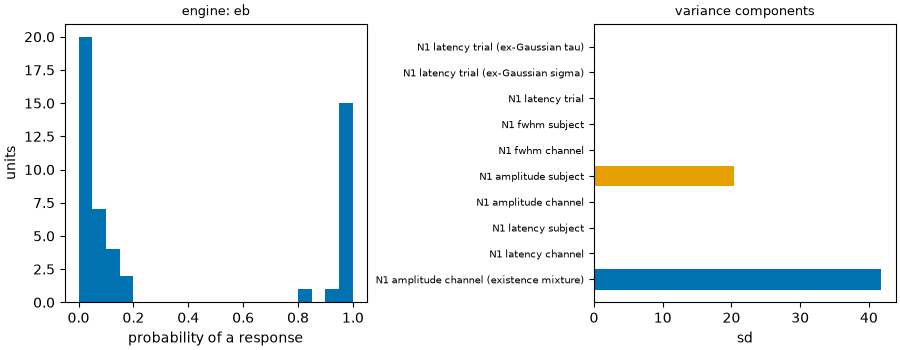
variance_components splits the spread of the N1 into between-subject,
between-channel and between-trial parts. It answers “would more subjects or more trials
help most?”: if most variance is between subjects, add subjects; if between trials, add
trials. The figure shows the group estimate and the subject spread.
print(hier.variance_components.round(4).to_string(index=False))

fig = plots.plot_hierarchical(hier)
component parameter                       level      sd                       method
       N1 amplitude channel (existence mixture) 41.8276    EM, two-component mixture
       N1   latency                     channel  0.0077                         REML
       N1   latency                     subject  0.0000                         REML
       N1 amplitude                     channel  0.0000                         REML
       N1 amplitude                     subject 20.4362                         REML
       N1      fwhm                     channel  0.0032                         REML
       N1      fwhm                     subject  0.0000                         REML
       N1   latency                       trial  0.0000 REML (residual beyond noise)
       N1   latency   trial (ex-Gaussian sigma)  0.0000                      moments
       N1   latency     trial (ex-Gaussian tau)  0.0000                      moments
Note
A covariate goes in through a formula. fit_hierarchical(subjects,
components=["N1"], formula="latency ~ age") regresses the N1 latency on each
subject’s age (read from the metadata) while keeping the pooling. For full posteriors
and credible intervals, engine="numpyro" or engine="pymc" (optional extras)
fit the same model with MCMC; compare_hierarchical then contrasts several fits.
Conclusion
The hierarchical model is how you go from one recording to a group result. It pools trials, channels and subjects in one step, trusts each unit by how well it is measured, and returns a group estimate with uncertainty plus a variance breakdown that guides the next study’s design. Empirical Bayes is the fast default; the Bayesian engines are there when you need the whole posterior.
Total running time of the script: (0 minutes 8.165 seconds)